<?xml version="1.0" encoding="utf-8"?><feed xmlns="http://www.w3.org/2005/Atom" ><generator uri="https://jekyllrb.com/" version="3.10.0">Jekyll</generator><link href="https://purohit10saurabh.github.io/feed.xml" rel="self" type="application/atom+xml" /><link href="https://purohit10saurabh.github.io/" rel="alternate" type="text/html" /><updated>2026-04-22T13:39:43+00:00</updated><id>https://purohit10saurabh.github.io/feed.xml</id><title type="html">Saurabh Purohit blog</title><subtitle>About me</subtitle><entry><title type="html">Why do I travel?</title><link href="https://purohit10saurabh.github.io/travel/" rel="alternate" type="text/html" title="Why do I travel?" /><published>2026-04-22T00:00:00+00:00</published><updated>2026-04-22T00:00:00+00:00</updated><id>https://purohit10saurabh.github.io/travel</id><content type="html" xml:base="https://purohit10saurabh.github.io/travel/"><![CDATA[<p>I have travelled to 14 countries so far. I have travelled solo, with friends, and with strangers. In this post, let me share some findings from my travel experiences!
<!--more--></p>

<h2 id="my-favorite-places">My favorite places</h2>
<p>Of all the places I have visited, my favorite places are:</p>
<ul>
  <li><strong>Rome, Italy</strong>: A mind-blowing city where architecture, history, and food come together beautifully.</li>
  <li><strong>Osaka, Japan</strong>: Jack of all trades. A well-rounded city that is good(not great) for everything- nature, beauty, culture, nightlife, city life, history, and food.</li>
  <li><strong>Rishikesh, India</strong>: My favourite place for a longer stay. It has great vibes, great vegan food, fun people, and a deeply relaxing environment.</li>
</ul>

<h2 id="what-solo-travel-taught-me">What solo travel taught me</h2>

<p>I have solo travelled to a few places like Finland, Bhutan, Andaman and Nicobar Islands. Recently, in November 2025, I spent a month travelling solo across North India. One thing I realised is that solo travel demands much more from you than travelling with others.</p>

<p>Your decisions carry real consequences. On a trek, for example, you try to carry exactly you need – nothing more, nothing less. That means you must think carefully about what you would truly need. If you pack unnecessary things, they become a burden. If you forget something essential, you may get into a trouble.</p>

<div style="background:#2a2b3d;color:#d4d4dc;border-left:4px solid #7aa2f7;padding:0.8em 1em;margin:1.5em 0;border-radius:4px;font-style:italic;font-size:1.05em">
This process of taking decisions and facing the consequences taught me a lot about myself. I became more aware of my preferences and limitations, and I learned how to explore independently. 

After coming back home, I let go of things that I didn't need -- I left my previous gym for a new better gym, decorated my house, got new clothes and made new friends. It is great to see these changes that come from solo travel.
</div>

<p>Such gems of learnings and experiences are why I travel!</p>

<p>Since everyone gets different travel experiences, I think the best approach is to explore different places and different styles of travel, whether solo, with a group of new people, or with friends. In doing so, you find your own way of travelling and a few gems along the way. 😁</p>]]></content><author><name></name></author><category term="life" /><summary type="html"><![CDATA[I have travelled to 14 countries so far. I have travelled solo, with friends, and with strangers. In this post, let me share some findings from my travel experiences!]]></summary></entry><entry><title type="html">A fascinating counterintuitive phenomenon in high dimensions</title><link href="https://purohit10saurabh.github.io/hds/" rel="alternate" type="text/html" title="A fascinating counterintuitive phenomenon in high dimensions" /><published>2026-03-20T00:00:00+00:00</published><updated>2026-03-20T00:00:00+00:00</updated><id>https://purohit10saurabh.github.io/hds</id><content type="html" xml:base="https://purohit10saurabh.github.io/hds/"><![CDATA[<p>Machine learning works in high dimensional spaces. These spaces exhibit many counterintuitive phenomena often called the <a href="https://en.wikipedia.org/wiki/Curse_of_dimensionality" target="_blank">Curse of Dimensionality</a>. In this post, we explore such a fascinating counterintuitive phenomenon that arises in high dimensions. Let’s dive in!
<!--more--></p>

<p>I found about this paradox in Richard Hamming’s <a href="https://www.youtube.com/watch?v=AD4b-52jtos&amp;list=PL2FF649D0C4407B30" target="_blank">Learning to Learn</a> lecture series. One of my favorite quotes from the series is-</p>
<div style="background:#2a2b3d;color:#d4d4dc;border-left:4px solid #7aa2f7;padding:0.8em 1em;margin:1.5em 0;border-radius:4px;font-style:italic;font-size:1.05em">
"In Science, you shouldn't do what you know; In Engineering, you shouldn't do what you don't know."
</div>

<h3 id="the-fun-counterintuitive-phenomenon">The Fun Counterintuitive Phenomenon</h3>
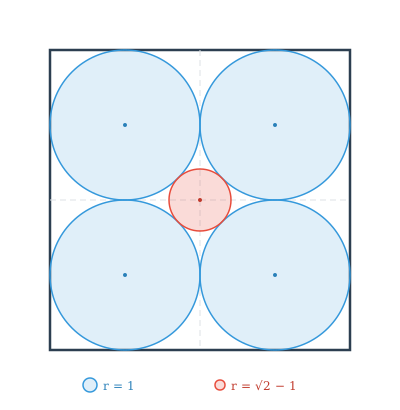
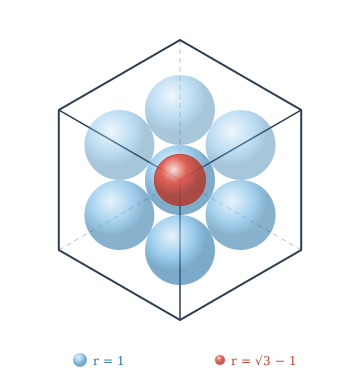
<p>Scroll down to see the visualisation of this. Let’s consider a d-dimensional space with a $d$-dimensional box centred at the origin. Its sides have length 4 (stretching from -2 to 2). So its corners are at $(\pm 2, \pm 2, \ldots, \pm 2)$. We add $2^d$ balls of radius 1 with centres at $(\pm 1, \pm 1, \ldots, \pm 1)$. These corner balls touch the sides of the box. Now we add the largest possible ball in the space between the $2^d$ balls.</p>

<p>What is the radius of this central ball? The center of a corner ball sits at $(\pm 1, \pm 1, \ldots, \pm 1)$, which is exactly $\sqrt{d}$ distance away from the origin. Since those corner balls have a radius of 1 and our central ball touches them, its radius is <strong>$\sqrt{d} - 1$</strong>. Let’s visualise this in 2D, 3D, and higher dimensions.</p>

<h3 id="2d-four-balls-in-a-square">2D: Four balls in a square</h3>

<p>Picture four unit(with radius 1) balls in a 4x4 square. The central ball has a radius of $\sqrt{2} - 1 \approx 0.41$. It sits comfortably in the middle, touching the four corner balls.</p>

<div style="text-align:center;margin:1.5em 0">
<img src="/assets/hds-2d.svg" alt="2D ball packing: 4 unit balls in a square with central ball" style="max-width:380px;width:100%" />
</div>

<h3 id="3d-eight-balls-in-a-cube">3D: Eight balls in a cube</h3>

<p>In 3 dimensions, we have eight unit balls packed into a 4x4x4 cube. The central ball gets larger with a radius of $\sqrt{3} - 1 \approx 0.73$. It is still well within the box, touching the eight corner balls.</p>

<div style="text-align:center;margin:1.5em 0">
<img src="/assets/hds-3d.svg" alt="3D ball packing: 8 unit balls in a cube with central ball" style="max-width:400px;width:100%" />
</div>

<h3 id="the-problem-in-higher-dimensions">The Problem in Higher Dimensions</h3>

<p>What happens as we keep adding dimensions?</p>

<p>At $d = 9$, the central ball’s radius hits exactly 2. It now touches the walls of the box.</p>

<p>But at $d \geq 10$, things get wild. The central ball’s radius is $&gt; 2$. The ball that we squeezed <em>between</em> the corner balls is now bulging <strong>outside</strong> the original box!</p>

<div style="background:#2a2b3d;color:#d4d4dc;border-left:4px solid #7aa2f7;padding:0.8em 1em;margin:1.5em 0;border-radius:4px;font-style:italic;font-size:1.05em">
How can a ball, squeezed between other balls in a box, grow larger than the box itself?
</div>
<p>This is the paradox! Try to grasp this intuitively before checking the explanation below.<br /><br /></p>

<details>
<summary>An intuitive explanation</summary>
<p>
Let's see what happens when we walk on the cube from its closest point to the origin to its furthest point. Let's take the closest point to the origin as $\vec{x}_0 =(2, 0, 0, \ldots, 0)$ and the furthest point as $\vec{x}_1=(2, 2, 2, \ldots, 2)$. Now if we walk on the cube from $\vec{x}_0$ to $\vec{x}_1$ along a straight line, the path $\vec{x}(t)$ is given by:
<br />
$$
\begin{aligned}
\vec{x}(t) &amp;= \vec{x}_0 + t(\vec{x}_1 - \vec{x}_0) \\
           &amp;= (2, 0, \ldots, 0) + t\big((2, 2, \ldots, 2) - (2, 0, \ldots, 0)\big) \\
           &amp;= (2, 2t, 2t, \ldots, 2t) \quad \text{for } t \in [0, 1]
\end{aligned}
$$
The distance $\|\vec{x}(t)\|$ between point on the cube and the origin is:
$$ 
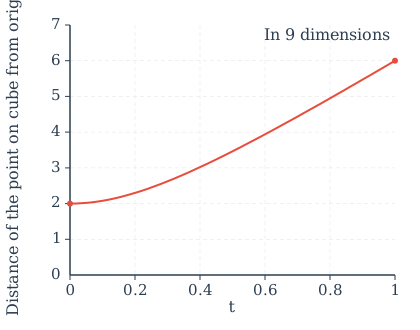
\|\vec{x}(t)\| = \sqrt{(2, 2t, 2t, \ldots, 2t)} = 2\sqrt{1 + (d-1)t^2}
$$
The distance increases from 2 to $2\sqrt{d}$ as t goes from 0 to 1. The corner of the cube is $2\sqrt{d}$ units far away from the origin while the nearest point on the cube is only 2 units away. This is shown in the below plot of distance of trajectory $\vec{x}(t)$ from origin vs t for d=9. 
<a href="https://www.desmos.com/calculator/dwxyjijtln" target="_blank">[Desmos link]</a>.
<div style="text-align:center;margin:1.5em 0">
<img src="/assets/hds-corner-distance.svg" alt="Corner distance in high dimensions" style="max-width:400px;width:100%" />
</div>

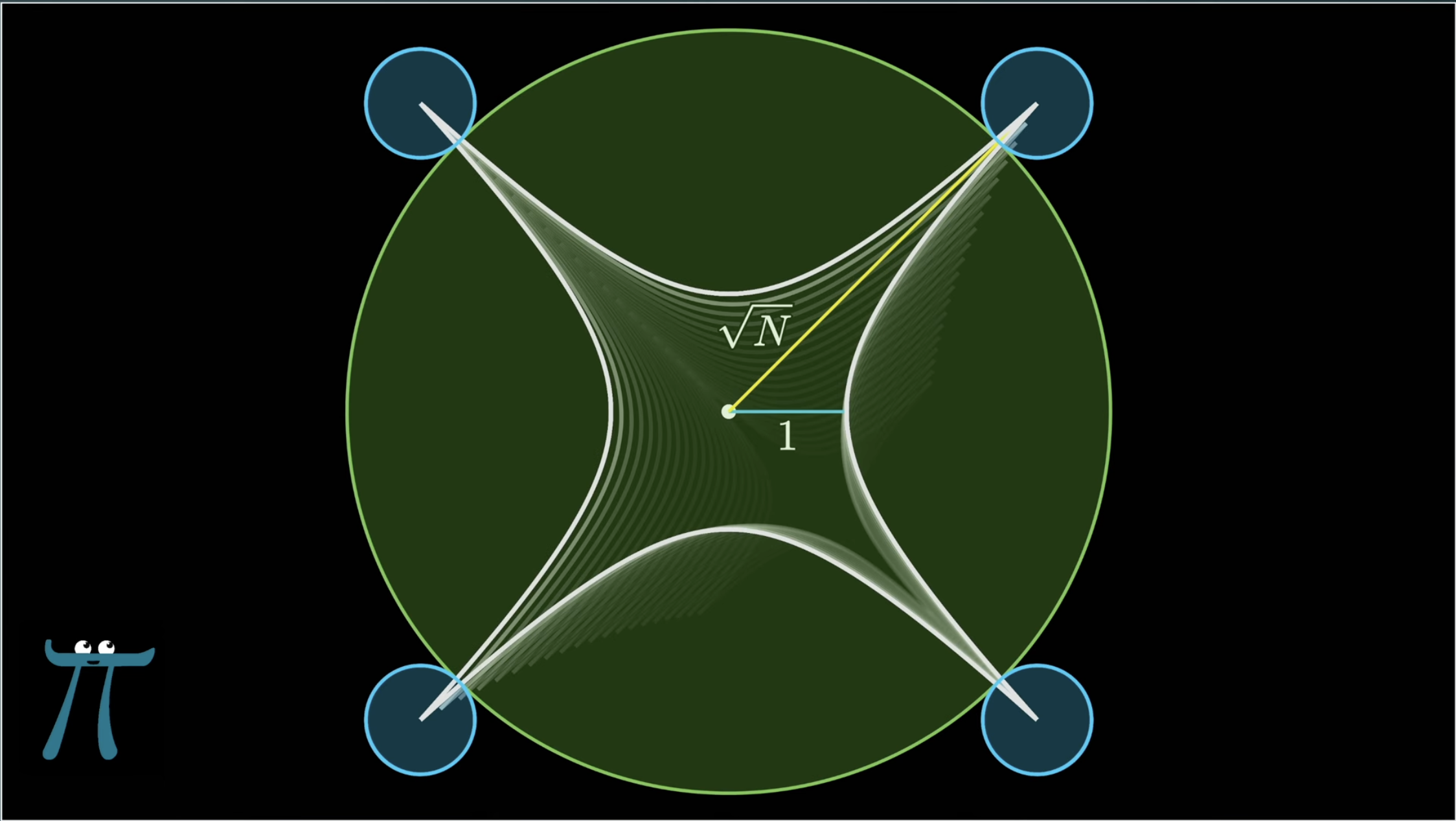
The corner ball with radius 1 has centre at $(\pm 1, \pm 1, \ldots, \pm 1)$ and is $\sqrt{d}$ units far away from the origin. Since the central ball has to be large enough to touch it, it will eventually get larger than radius 2 thereafter bulging outside the cube. 
<br /><br />
Finally, a 2D visualisation of N-dimensional cube by <a href="https://www.youtube.com/watch?v=fsLh-NYhOoU&amp;t=830s" target="_blank">3Blue1Brown</a> showing the large difference in distance of its closest and furthest points from origin is shown below.<br />
<div style="text-align:center;margin:1.5em 0">
<img src="/assets/hds-nd-cube.png" alt="N-dimensional cube in 2D" style="max-width:400px;width:100%" />
</div>
</p>
</details>]]></content><author><name></name></author><category term="blog" /><summary type="html"><![CDATA[Machine learning works in high dimensional spaces. These spaces exhibit many counterintuitive phenomena often called the Curse of Dimensionality. In this post, we explore such a fascinating counterintuitive phenomenon that arises in high dimensions. Let’s dive in!]]></summary></entry></feed>